West Chiba · FuttsuNo.943★Open in map →
Meiji Centennial Observation Tower
— A stacked concrete lookout at the tip of Cape Futtsu
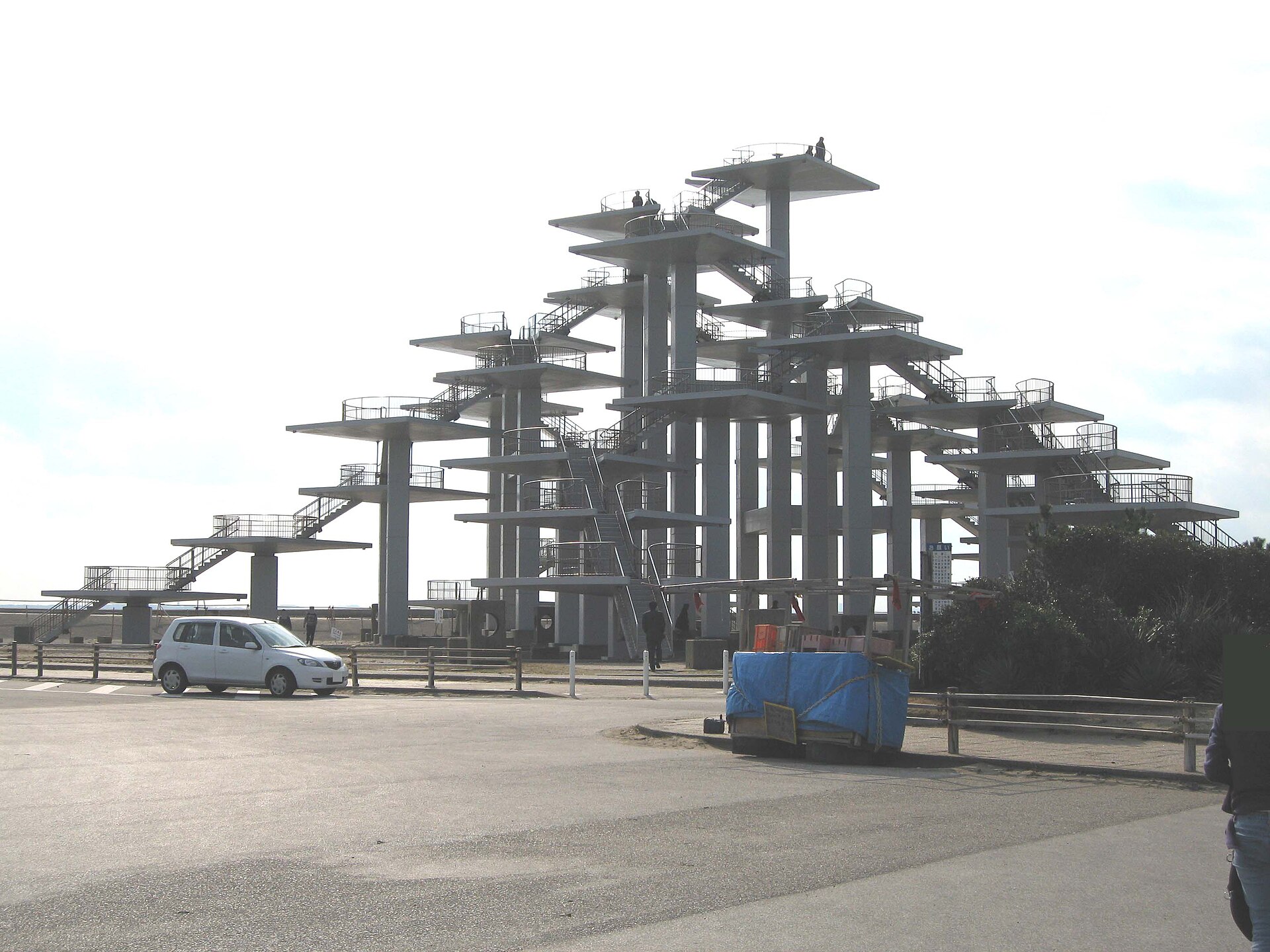
A concrete tower at the far tip of Cape Futtsu, raised to mark the centenary of the Meiji era and shaped after a five-needle pine. Square decks are stacked at staggered heights, and the climb ends with Tokyo Bay on three sides.
- FromTokyo Station
- ~2 hr 30 minJR Uchibo Line, then a local bus
- Get off atAobori Station (JR Uchibo Line)
- From there
- Meiji Centennial Observation Tower
The sweet spot
This is not an obscure place. It appears on the Kanto region's official list of a hundred Fuji viewpoints, and the prefecture notes the tip of the cape as a place people come for the evening. What is unusual is the structure itself. The floors are many and the stairs branch, so there is no one platform to queue for.
Where it is
50 more notes in Chiba · open the map →What to look for — in walking order
- Naka-no-shima Lookoutthe park's other and smaller viewing tower, close to where the bus sets down
- The branching staircasessteel flights threading between floors set at different heights, with several ways up
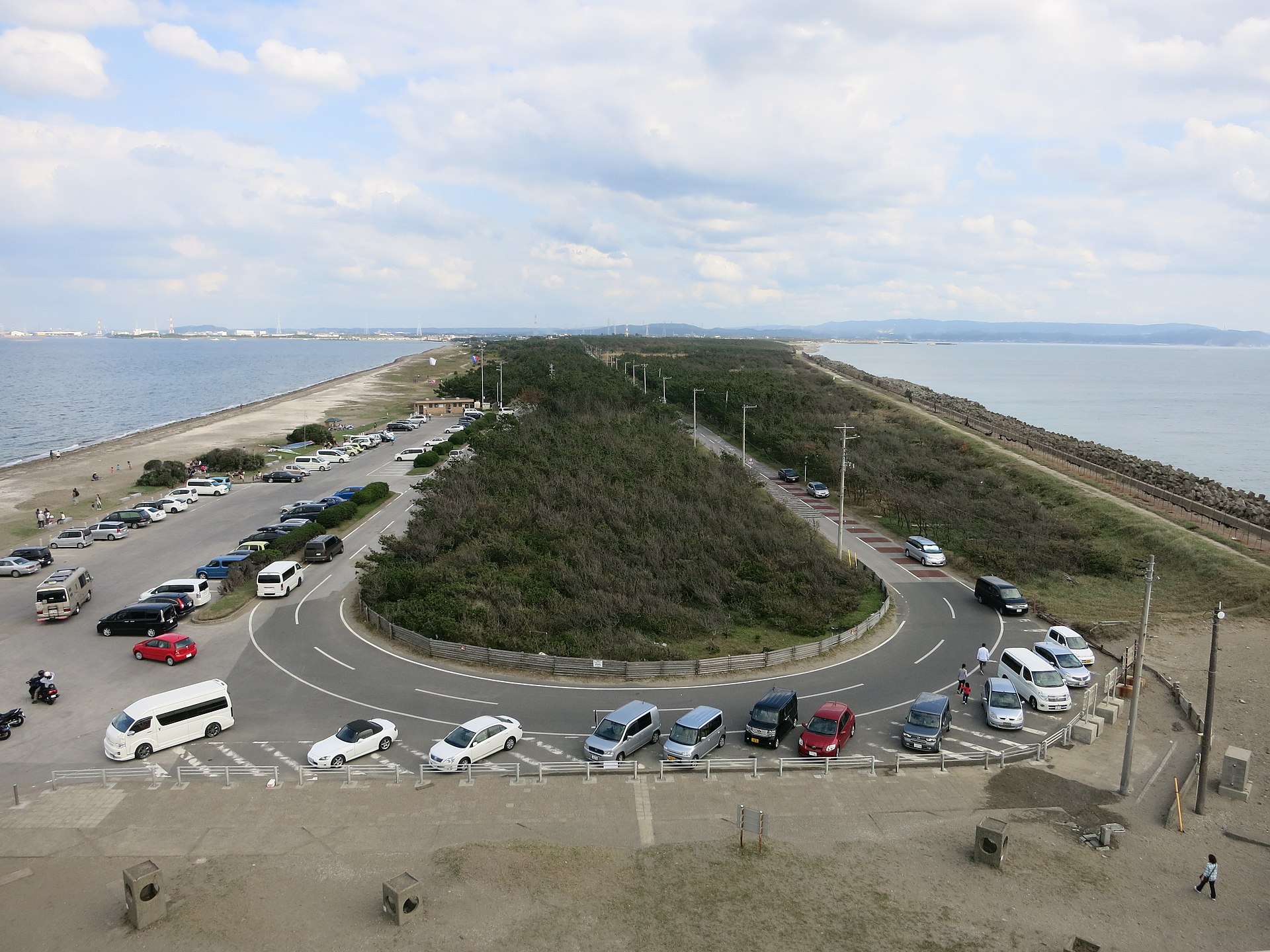
- The top floorthe highest deck of the tower, with open water to the north, west and south
- The sea forts and Mount Fujitwo Meiji-era artificial islands offshore, with the cone beyond the Kanagawa shore in clear air
How to actually get there
- Tokyo Station → Aobori Station (JR Keiyo and Uchibo lines, toward Kimitsu).
- Aobori Station → Futtsu-koen (Nitto Kotsu Futtsu line bus, stay on to the terminus).
- Futtsu-koen terminus → the tip of the cape (about 20 min on foot, past the Naka-no-shima lookout).
- Climb the stacked decks to the top floor, then return the same way for the bus.
- JR Uchibo Line to Aobori, then the Futtsu-koen bus
- From Tokyo Station take the JR Keiyo and Uchibo lines toward Kimitsu and get off at Aobori. Outside the station, board the Nitto Kotsu Futtsu line bus signed for Futtsu-koen and stay on to the terminus. From there the road runs west along the spit, and it is about twenty minutes on foot to the tower, passing the smaller Naka-no-shima lookout on the way.
- Back from Futtsu-koen
- Walk back to the Futtsu-koen stop and take the Futtsu line bus to Aobori, where the JR Uchibo Line runs north toward Chiba and Tokyo. Some services carry on past Aobori to Kisarazu-nishiguchi, which helps if you are joining the Aqua-Line coaches. Departures thin out in the evening, so read the last one at the stop before you walk to the tip.
About the place
Cape Futtsu is a sandspit reaching west into Tokyo Bay from the Chiba shore, and the tower stands on its last stretch of land. Chiba Prefecture, which manages the park around it, describes the design as a five-needle pine rendered in concrete — square floors spreading at different heights, with stairs threading between them like a three-dimensional maze. The top floor stands 21.8 metres up. From there the water lies to the north, west and south, with the far shore of the bay in Kanagawa across the channel.
How to enjoy it
Chiba Prefecture's own notes single out the evening here, when the sun drops over the bay behind the Kanagawa shore. Both the city and the prefecture add that Fuji shows only on clear days, so the view is a question of the air rather than the hour. From the Futtsu-koen bus terminus it is about twenty minutes on foot to the tip, and an hour and a half on the ground covers the walk out, the climb and the walk back.
Background & history
This ground was military land before the war and was transferred from the state to Chiba Prefecture afterwards; the prefecture dates the park's planning to 1951. The site was later designated a Meiji Centennial park by the national government, and the tower was built as the memorial that designation called for. Prefectural records give its completion as 31 March 1970. Offshore lie the First and Second Sea Forts, artificial islands raised between the Meiji and Taisho eras to guard the sea approach to the capital.
Before you go
- Cash
- Futtsu Tourism Association lists the ordinary rail fare from Tokyo to Aobori as 1,450 yen, with a limited-express supplement of 900 yen, and the Aobori to Futtsu-koen bus at 300 yen. Futtsu City notes that the Futtsu line bus takes IC cards as well as cash. Chiba Prefecture's travel guide records the park car parks as free.
- Before you go
- The tower is open framework with no walls, so wind and rain reach every floor. It was closed for refurbishment from November 2022, and Futtsu Tourism Association announced on 30 March 2023 that the work had finished and the tower was usable again. The spit itself has no shelter, and the last stretch to the tip is open sea on both sides.
- Another way
- From the Kanagawa side, the Tokyo-Wan Ferry crosses from Kurihama to Kanaya in about forty minutes, and the JR Uchibo Line runs north from Kanaya to Aobori. Highway coaches on the Kimitsu route also reach Aobori from the Yaesu side of Tokyo Station, which Futtsu Tourism Association times at about eighty minutes.
- After you get off
- Aobori Station is the rail stop, and the Futtsu-koen bus leaves from in front of it. The terminus is inside the park; from there a single road runs west along the back of the spit, sea on both sides, and the tower stands at the end of it.