Column October 1, 2026
At Kusatsu's Yubatake, Hot Spring Deposits Are Collected by Hand
Through the steam, rows of wooden channels carry hot water in the middle of town. This is the Yubatake, at the centre of Kusatsu Onsen. Most visitors, I suspect, take a photo and move on.
Look at the name. Yu is hot water; hatake is a field. The Kusatsu Onsen Tourism Association explains it as “a field where yunohana can be collected” — yunohana being the mineral deposits a hot spring leaves behind. And yunohana really is collected here.
The spring itself rises inside the field. According to Japan’s Agency for Cultural Affairs, it gives 4,040 litres a minute, at 52.7°C and a strongly acidic pH of 2.1. Part of the water runs through seven wooden channels, each about 40 metres long; the rest flows past them.
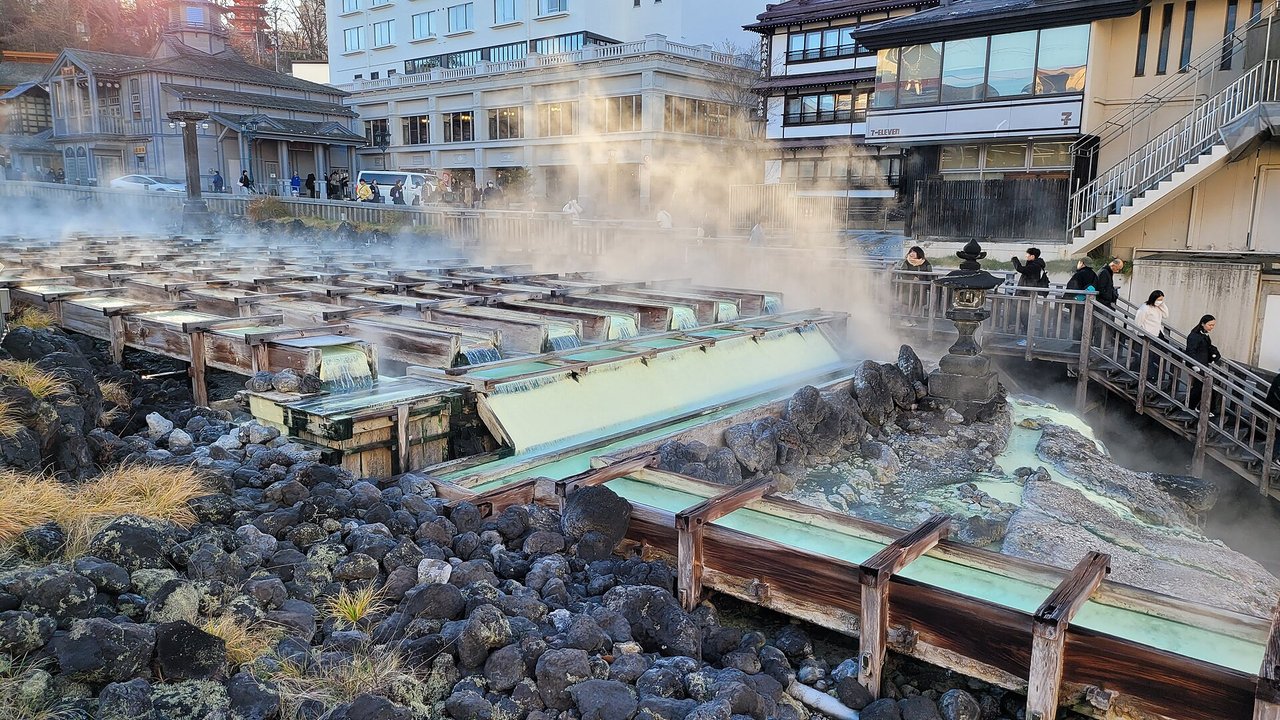
As the water runs through the channels in the open air, it cools, and its minerals settle on the bottom. That sediment is yunohana.
The collecting is done by hand. According to Kusatsu Onsen’s Senshitsu Shugi website, once every two months the flow is stopped for a while and the deposits are scraped out by hand.
The strange part is that water this acidic, at pH 2.1, runs through wooden channels. The same website says the channels are 5-centimetre-thick pine, still full of its own resin, and that resin-rich pine or cypress is the best material to stand up to acidic water. The agency notes that the current channels are red pine from trees more than 150 years old. It says the channels were installed in the Meiji 20s, the years 1887 to 1896, and are still replaced from time to time.
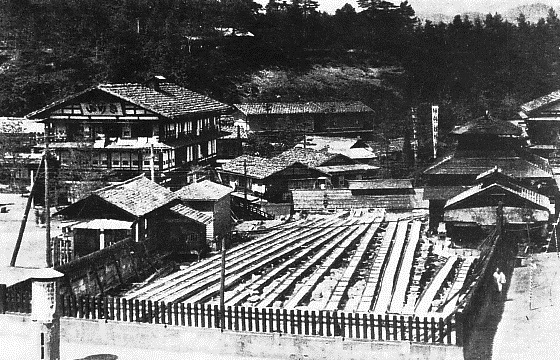
The fence has changed too. It was wooden until the Shōwa era began, and a stone fence was built in 1934. The stone fence you see today dates from 1975 and was designed by a contemporary art institute headed by the artist Tarō Okamoto.
If you go, stand at that stone fence and look into the channels. The water is on its way to more than 80 inns, communal baths and other places around town. On the bottom, the next batch of yunohana is settling.
The yunohana that Kusatsu town sells through shops and inns is, according to the town, what settles in these channels, collected and dried.